
The Catalog Wasn’t Complete
Then Someone Sent Me a Childhood Photo From 1977

I’m lucky that my mother took and held on to hundreds of photos from my childhood. As a kid, they didn’t feel important—just recent documents of disappeared freckles and clothes that had gone out of style. I doubt I ever saw them during college or even my early adult years, other than the few my mother kept in small frames around her house.
Then at some point, probably in my 30s, the photos started to matter. I’d flip through an album when I visited my mother, or she’d send me a few in the mail—acting like she knew I liked them, but also clearly making an effort to clean out. Eventually, I had a big box of about 600 photos. Some were baby pictures with my mother and my uncle, both young and visibly excited, and also not quite sure what to do with me. Many are in brilliant ’70s color, with greens and oranges bursting from the corners. Others feel more stately in black and white, with thick white borders. I love them all, but I remain most interested in the ones from age two to about nine: still a scrappy kid who didn’t yet have braces or a haircut from anyone other than my mother. They’re littered with drums, bikes, Halloween costumes, Kiss memorabilia—it’s a photographic commercial for the 1970s.
During the pandemic, I finally took the time to organize and scan every photo—placing each one in what felt like the correct order based on the faint printed dates on the backs of some of the glossy 3x5s, or by the outfits I wore, the size of my Afro, or the beat-up-ness of my drum set. And now I never look at them. I don’t need to—they’re ingrained in my memory, like the cheat sheet you make for a test and never actually need (or so I’ve heard). I have the catalog. The exercise is complete.
Then, a few weeks ago, someone got in touch via Facebook Messenger:
Hello Nabil, I knew your mom and you in the late 70’s. I used to come to Cambridge to visit and check you out as a drummer. You were about 6 or so, played the drums so well I was amazed. Then you moved to Amherst and I lost touch with you and your mom. I’m a Baha’i from Boston. Here’s a photo of us in the late 70’s. We had a good time together.
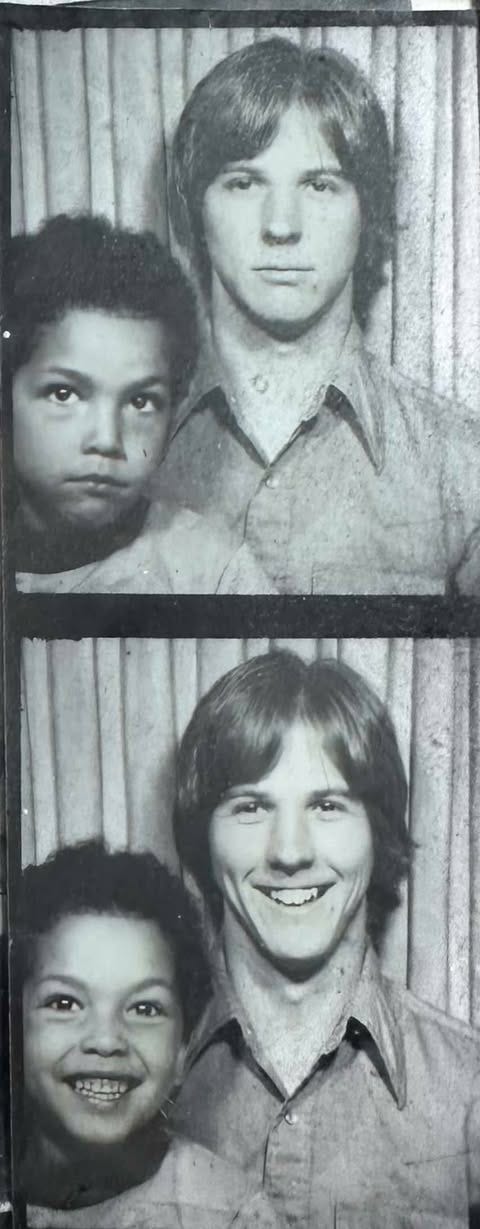
It’s one thing to always know your childhood photos, and another to re-familiarize yourself with them by cataloging them as an adult. But it’s something else entirely to receive a 40-something-year-old photo you’ve never seen. These aren’t my favorite kid photos—I’m not even smiling in one of them—but they’re an incredible snapshot of a time and place. Likely around 1977 in Cambridge, when I’m five. It looks like we’re in a photo booth in a store, and I honestly don’t remember the drummer who was friends with my mother and held onto these photos all that time.
This has only happened to me once before. In 2018, someone else reached out—also on Facebook, and also a Baha’i—with five photos of me, my mother, and my uncle at a wedding in Cambridge. I wrote about that experience in My Life in the Sunshine—how powerful the photos were and how serendipitous the timing felt, arriving alongside some important paternal connections.
Those photos felt heavier and more emotional. This feels lighter, more fun. In the top photo, it looks like someone told us both to act serious. In the bottom one, it looks like someone told us to act normal—which for me then, and apparently for my adult drumming accomplice, meant a big smile.
Looking at these pictures feels like I get to re-live a moment of my childhood—like I thought I knew every moment, 600 of them at least, and now I have one more. I wish it were a video with a quick snippet of my voice. I wish I could ask what we had for lunch right before the photo, or what songs we played on drums afterward. But I’ll never know.
Instead, I get to live with one of my favorite things about old photographs: no context, no answers, no captions to fill in the gaps. Just proof that even a childhood I thought I’d fully accounted for still has room to surprise me.
My guest on Identified this week is the acclaimed comedian, actor, and musician Tim Heidecker for an unexpectedly candid conversation about ancestry, grief, and identity. Tim traces the impact of family tragedy across generations—from the death of his grandfather’s mother in childbirth, to the sudden loss of a sibling in his father’s childhood, and how that subtly shaped his own upbringing in suburban Pennsylvania.

My memoir is called My Life in the Sunshine. You can order it here, or listen to the audiobook on Spotify.
The tension between thinking you have the complete record and then getting ambushed by new evidence hits different when it's your own life. That line about the cheat sheet you make for a test but never need is spot on because cataloging becomes its own kind of mastery separate from the actual memories. Had something similiar happen when an old neighbor sent me a photo from a birthday party I'd completely forgtten. The lack of context in old photos is what makes them powerful rather than limiting, since we fill gaps with imagination instead of facts.